
Criminal Cases in the Galveston County Courts
Galveston County divides criminal files by the level of the charge. The 10th, 56th, 122nd, 212th, and 405th Judicial District Courts have general criminal jurisdiction and hear felony matters among their dockets. County Courts at Law 1, 2, and 3 hear Class A and Class B misdemeanors. Fine-only Class C charges remain with the municipal or justice court that received the citation. The 306th District Court is a family court, so it should not be treated as another adult criminal trial court.
The Galveston County District Clerk Criminal Section keeps district criminal case records. The County Clerk holds files for the County Courts at Law. Both sets of courts operate at the Justice Center in Galveston. A cause number and court name are the best routing details. They distinguish a filed case from a sheriff booking, a city citation, or a DPS criminal-history entry.
Galveston Criminal Case Portal Cutover
The county retired support for its legacy Public Access site at the end of 2025 and directed users to the current Tyler Odyssey Portal. That change matters when an old bookmark fails or when search instructions point to the former interface. The local notice also says re:SearchTX serves family, probate, and civil cases in this setting. It is not a complete substitute for the county's public criminal search.
The Galveston County Odyssey Portal is the source for the criminal case index. The official portal screen below shows why a user should begin at the county route rather than assume one statewide Texas database contains every trial-court file.
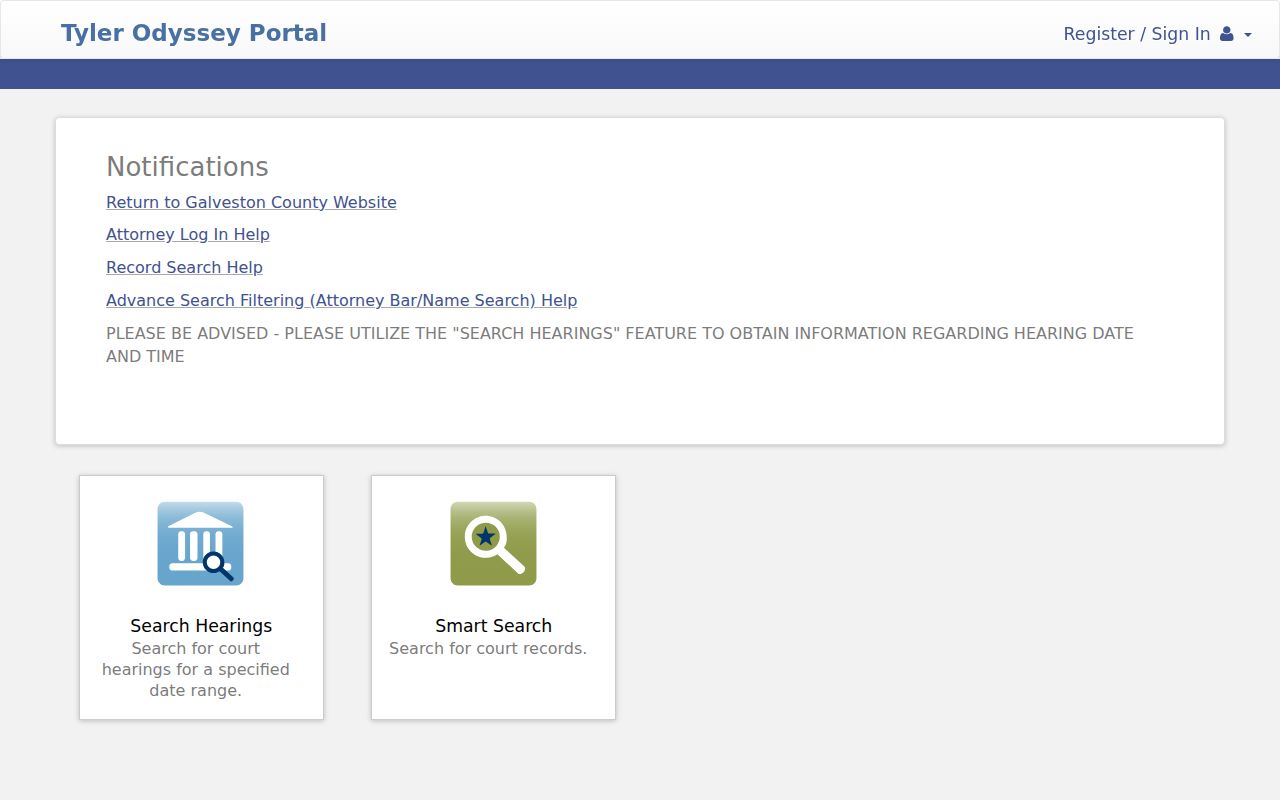
Once a result appears, keep its cause number, assigned court, and filing date. Those details let the clerk find a judgment or other document even if the portal does not offer a public download.
How to Search Case Records
A name can return several people or several files for one person. Start broad, then narrow with court, case type, status, and filing dates. Check the case header before relying on an event row. Filed charges may differ from the allegations recorded at booking, and an index entry does not guarantee that every document image is free or open online.
- Open the county Odyssey Portal and enter a party name or known cause number in Smart Search.
- Expand the advanced filters and choose the Galveston County court or location when that control is available.
- Select the criminal case type, then narrow by party role, filing dates, or status as needed.
- Open the case header and read the charge, event register, settings, disposition, and financial entries in context.
- Ask the District Clerk for felony documents or the County Clerk for misdemeanor documents when a judgment or dismissal is not downloadable.
| Field Label | Type | Required | Notes |
|---|---|---|---|
| Smart Search | Text | Yes for search | Use a party name or cause number; syntax can vary by portal version. |
| Advanced Filtering Options | Expandable control | No | Opens added filters. |
| Location / Court | Dropdown | No | Choose a configured Galveston County court or location. |
| Case Type / Party Type | Dropdown | No | Select criminal and the relevant party role when shown. |
| Filed From / Filed To | Date | No | Limits results by filing date. |
| Case Status | Dropdown | No | Uses the open, closed, or other statuses configured in the portal. |
Five Galveston Felony Case Courts
All five general-jurisdiction district courts sit at 600 59th Street, but the assigned court is not a minor detail. Each court has its own judge, coordinator, settings, and docket rhythm. The official directory identifies the 10th, 56th, 122nd, 212th, and 405th District Courts. A searcher should contact the coordinator listed for the assigned court about a setting, while requests for the filed record itself go to the District Clerk.
Three County Courts at Law share the Justice Center and handle the county's misdemeanor files. That split prevents a common mistake: asking the District Clerk for every criminal record merely because the case is at the same building. First read the charge level and court name. A felony belongs on the district side, a Class A or B misdemeanor on the county-clerk side, and a fine-only city or JP case with its own lower court.
What the Case File Shows
A criminal case file centers on one cause number and the prosecution that was actually filed. It can show the charging paper, court events, attorneys, hearings, disposition, judgment, sentence, and a financial ledger. It is different from a booking sheet, which captures the allegation and custody facts at intake. For outcome research, the signed judgment or dismissal is stronger evidence than a search-result label.
| Cause Number & Court | Identifies the file and the district, county, municipal, or justice court responsible for it. |
|---|---|
| Charging Document | Shows the complaint, misdemeanor information, or felony indictment and the charge presented to the court. |
| Parties & Attorneys | Lists the State of Texas, defendant, party roles, and attorneys of record where entered. |
| Docket Events | Tracks appearances, settings, motions, pleas, capias entries, orders, and case closure. |
| Disposition & Judgment | Records dismissal, acquittal, conviction, deferred adjudication, or another court outcome. |
| Sentence & Financials | May show confinement, community supervision, fines, court costs, and payments where public access permits. |
Exact birth dates, Social Security numbers, protected victim or minor data, and sealed or nondisclosed material are not proper public fields. A document index can list an item without making its image available.
Reading Galveston Criminal Case Outcomes
“Disposed” means the court reached a disposition. It does not mean the result was a conviction. The case may have ended in dismissal, acquittal, a guilty judgment, deferred adjudication, or another order. A nolle prosequi is the prosecutor's formal choice not to continue a charge. Deferred adjudication places a person on supervision without an immediate judgment of guilt, but the public court file does not vanish merely because supervision later ends.
- Disposition
- The recorded outcome of a charge or case.
- Indictment
- A grand jury's formal felony accusation, also called a true bill.
- Information
- A prosecutor's formal charging instrument, most often used for a misdemeanor.
- Capias
- A court writ directing an arrest, often tied to a filed charge or failure to appear.
- Deferred adjudication
- Court supervision that delays a judgment of guilt under Texas law.
Compare the filed charge with the final order because counts can be amended, rejected, or dismissed. For a broader trail from booking to prosecution, the county's arrest history records explain why the initial jail allegation can differ from the court charge.
Stages of a Criminal Case
An arrest can lead to magistration, but the lasting case file begins when a complaint, information, or indictment reaches the court. Texas law calls for an arrested person to go before a magistrate without needless delay, ordinarily within 48 hours. The prosecutor may then decline a case, change the charge, file a misdemeanor information, or present a felony matter to a grand jury.
Case flow: Charges Filed › Arraignment › Pretrial › Plea or Trial › Disposition › Sentencing
Arraignment is the point at which the charge is read and a plea is entered. Pretrial work can include discovery, settings, and motions. A plea or trial leads to the disposition. If there is a conviction, the judgment states the sentence. An appeal may create a related appellate record, while the trial clerk remains the source for the original Galveston County case file.
Galveston Criminal Records Clerk Counters
The District Clerk has two useful public counters. The main criminal-file counter is in Room 4001 at the Galveston County Justice Center. A satellite office at 174 Calder Road in League City gives mainland residents another route for clerk services. Users should call before travel to confirm that the needed criminal document and service are available at that location. Plain and certified copies can have different uses and fees, so ask for an estimate and state which form is needed.
Galveston County District Clerk
600 59th Street, Room 4001
Galveston, TX 77551
(409) 766-2424
Monday-Friday, 8:00 a.m.-5:00 p.m.
League City Satellite Office
174 Calder Road
League City, TX 77573
(281) 316-8729
Monday-Friday, 7:30 a.m.-5:30 p.m.
Bring the cause number, court, and party name. If no online image exists, ask whether the file is scanned, archived, available for inspection, or eligible for a certified copy.
Access & Restrictions
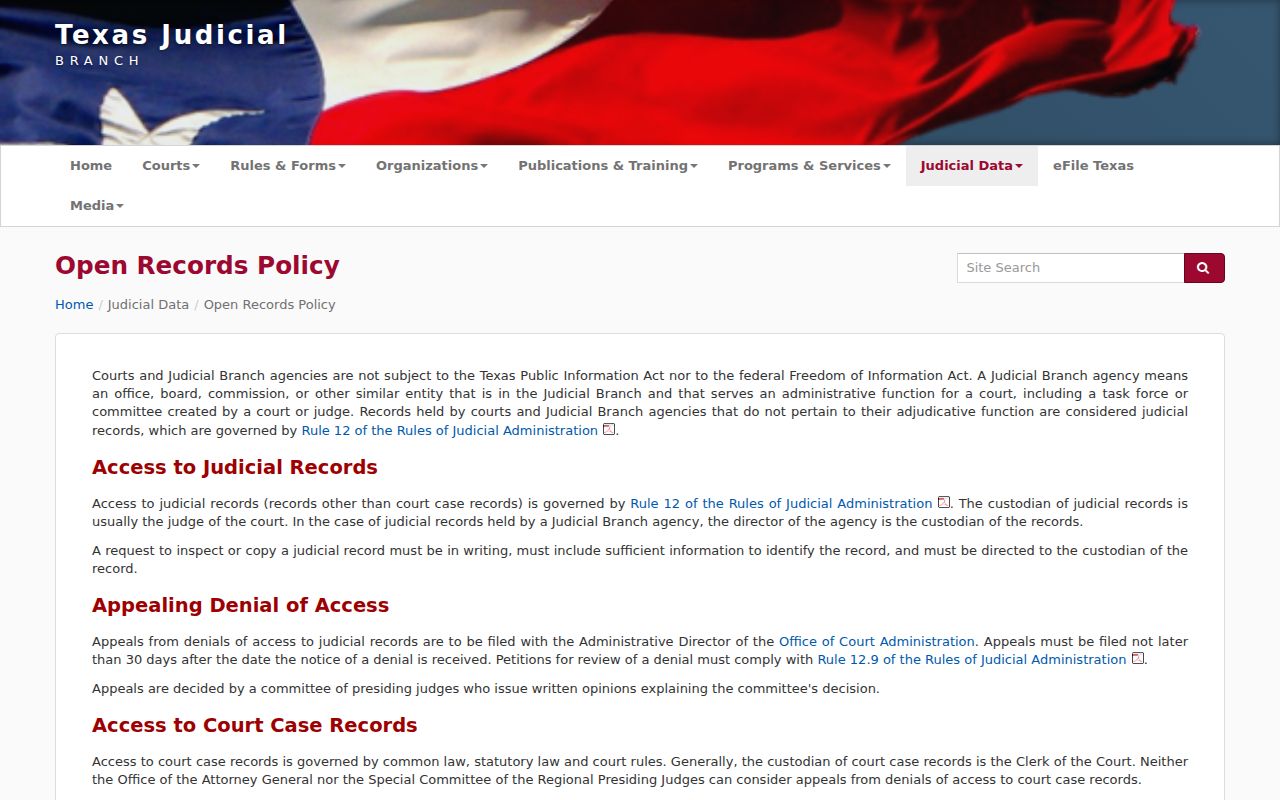
Court case records do not follow the same open-records route as a sheriff report. Texas court case files are governed by common law, statutes, and court rules. Judicial administrative records use Texas Rule of Judicial Administration 12. The Texas Judicial Branch access policy explains that distinction.
The state policy shown below helps separate a request for a filed pleading or judgment from a request for a court's administrative record. Sending a case-file request through the Texas Public Information Act can route it to the wrong process.
Public access still has firm limits. Juvenile matters, sealed and expunged records, nondisclosed history, confidential victim data, protected identifiers, and restricted documents may be absent or redacted. When a known file does not appear online, ask the correct clerk whether it is archived or restricted. Do not assume that a missing result means the case never existed.
Galveston Veterans Court Case Dockets
The Justice Center also houses the Galveston County Veterans Treatment Court. A specialty-court case may produce public docket entries for settings, orders, or supervision while clinical assessments and treatment details remain confidential. The public record should therefore be read at the right level. It can document what the court filed and ordered without revealing every fact used by the treatment team.
This local program also shows why the event register needs context. A string of specialty-court settings is not the final outcome. Check the judgment, any order placing the case into the program, later modification or completion entries, and the ultimate disposition. The clerk can identify public documents, but the absence of treatment details is a privacy boundary rather than proof that no program activity occurred.
Note: Confirm every criminal case outcome through the signed Galveston County judgment or dismissal, not a brief portal status alone.