
Running a Sex Offender Check in Galveston County
The Texas Public Sex Offender Registry is the main official channel for a Galveston County registry search. Texas Department of Public Safety publishes records tied to reportable convictions or adjudications. It is not a broad list of people accused of an offense. Begin with a county, city, ZIP, address, or name search that fits the question. A place search is useful for community awareness, while a name search works best when enough identifiers are known to avoid a mistaken match.
The Galveston County Sheriff's Office performs local registration and verification work, but the state registry is the authoritative public display. The sheriff's site also routes users to registry resources. If a profile seems wrong, note its registration number, reporting agency, and verification details before contacting the proper office. For urgent safety concerns, call law enforcement. For a possible data error or noncompliance issue, use the reporting route supplied by DPS rather than confronting anyone shown in a result.
Galveston County Registry Search Choices
Name and address searches answer different questions. A Galveston County name query is aimed at a known person, so first name, surname, age, and physical details help distinguish similar records. An address, ZIP, city, or radius query is a map-based view of reported locations. Save the place and radius used. A result outside that boundary may not appear, and a marker is only as current and exact as the information legally published.
The DPS registry map interface shows why the chosen search mode matters. The official screen below is an interface view, not a private registrant's profile.
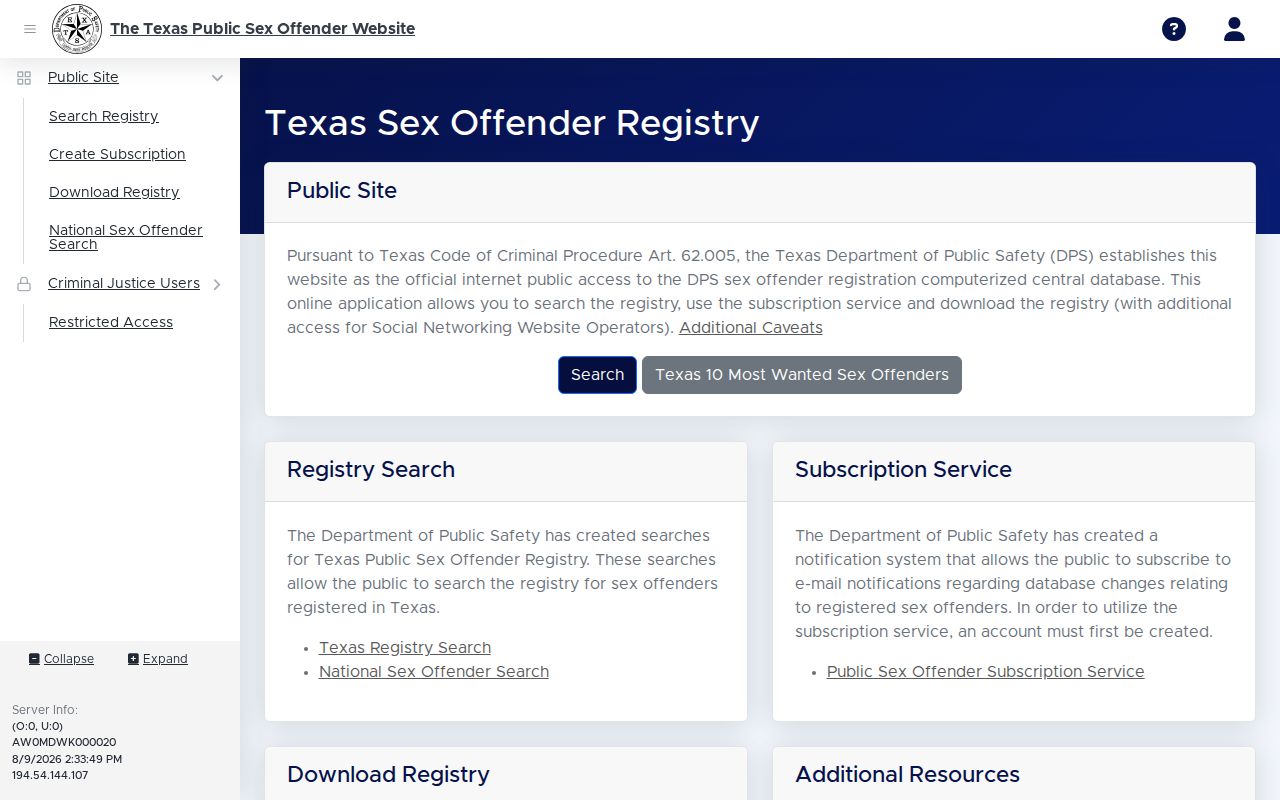
Use the map and list controls together, then open a result only after checking the basic identifying details. The map helps with place-based awareness; the profile supplies the record context.
Searching the Texas Public Sex Offender Registry
DPS maintains the statewide public search. A careful Galveston County sex offender check records the search path, location, and date, then reads the full profile instead of relying on a pin or result-row label.
- Open the official DPS registry and choose the search path that fits the facts: name, address, county, city or ZIP, or another location option shown.
- Enter the known terms. Choose Galveston for the county filter, or add a city, ZIP, address, or radius when the current interface permits it.
- Review the map or list. Compare the name and physical details before treating a row as the correct person.
- Open the full profile. Read the offense, reporting agency, registration status, address, and verification information together.
| Field Label | Type | Required | Notes |
|---|---|---|---|
| Search path | Tabs or links | One path | Name, address, county, city or ZIP, and other paths may appear. |
| Last Name | Text | Search-dependent | Starts a surname query. |
| First Name | Text | No | Narrows a name search. |
| Address | Text | Location search | Accepts a street or address input. |
| City or County | Text or select | No | Choose Galveston County or refine by city. |
| ZIP Code and Radius | Text and select | No | Options depend on the live interface. |
| Map or List | View control | No | Switches between geographic and row views where enabled. |
Run more than one search when the facts support it. A county filter gives breadth, while a name or address search can test a more focused Galveston County question.
Galveston County Registry Verification Roles
Publication and local verification are related, but they are not the same job. DPS operates the public Texas registry. Local law enforcement receives registration and change information, carries out verification duties, and reports data through the state system. In Galveston County, call the Sheriff's Office at (409) 766-2300 before going to an office. The research does not confirm a separate public registration-counter address or schedule, so an unplanned visit to the jail is not the right first step.
Chapter 62 sets registration, verification, and notification duties. The exact schedule can turn on the reportable offense, status, and other facts. A public user should not infer that an old photograph or a map location proves a missed duty. Note the profile fields and contact the reporting agency or DPS. This keeps the concern tied to the record custodian and gives officers the facts needed to check the underlying file.
What a Registry Profile Shows
A Galveston County registry profile joins identity details, the reportable offense, and registration data in one public record. Some fields vary by law and record status. Sensitive or nonpublic details are not displayed. The profile should be read as a registration record, not as a live location tracker or a full criminal case file.
| Name & Aliases | Published identity names and alternate names associated with the registration record. |
|---|---|
| Photo & Description | A recent published photograph plus sex, race, age or DOB, height, weight, hair, eyes, and visible marks when reported. |
| Registered Address | The address information that Texas law permits DPS to publish; it is not proof of current presence. |
| Offense & Court | Offense description or statute, conviction or adjudication date, disposition or court, and victim category when lawful. |
| Risk & Status | Texas risk level, registration number, registration status, and verification information where shown. |
| Agency & Other Fields | Reporting agency and vehicle, school, work, or institution information when reported and public. |
Match more than a name. Compare physical details, aliases, the reporting agency, offense, and dates. If the underlying conviction must be understood, use the court that entered it rather than trying to reconstruct the case from the public registry alone.
NSOPW Beyond Galveston County Records
The National Sex Offender Public Website is the official federal search layer when a person or address may cross a Texas border. It queries participating jurisdictions, so it is useful when someone recently moved, uses an out-of-state address, or cannot be found with a Galveston County filter.
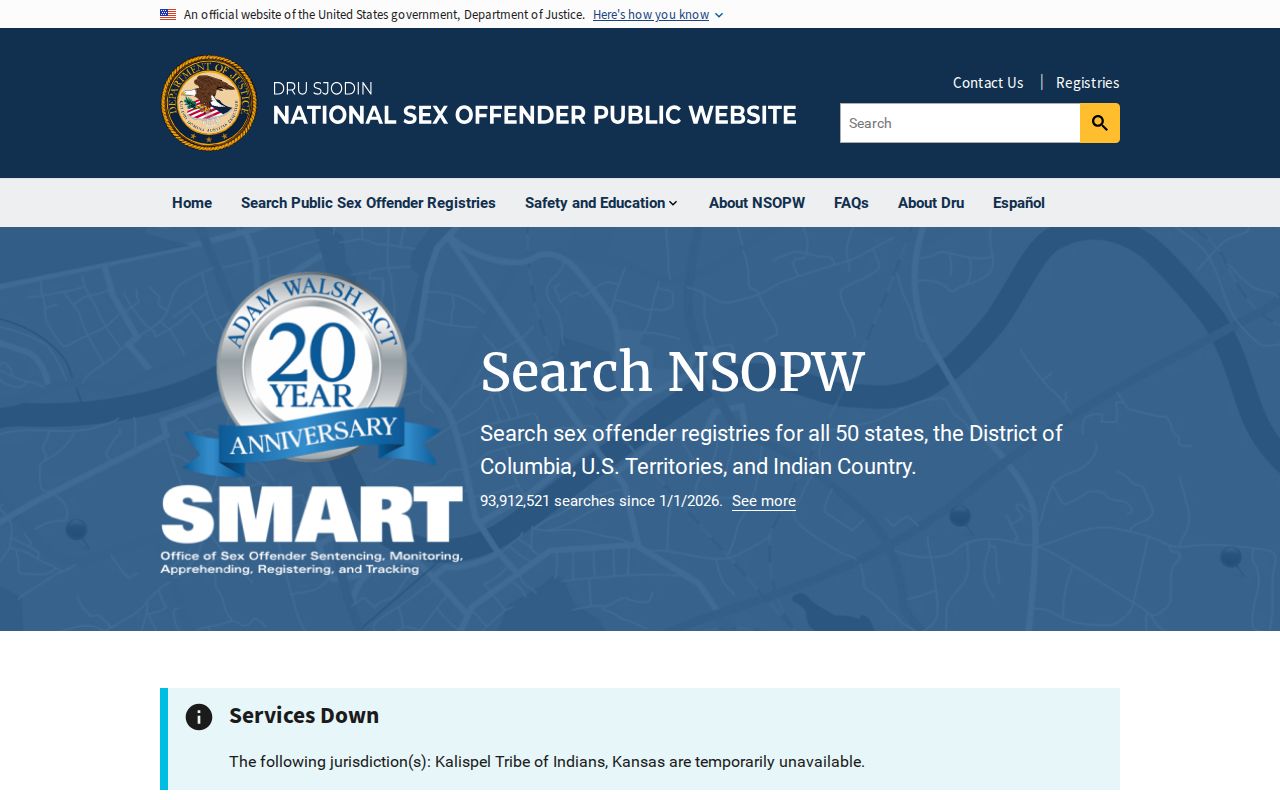
The national screen broadens geographic coverage, but it does not replace the detailed Texas entry. Return to DPS for the current Texas profile and to the listed reporting agency for questions about a Galveston County record.
Search limits still apply. Jurisdictions publish different fields, and a missing national result is not a safety clearance. Try reasonable name variants and location searches, then use official law-enforcement channels when there is a concrete concern. Do not use a commercial people finder as a substitute for either government registry.
Registration Requirements and Levels in Texas
Texas risk levels describe assessed risk, while registration duration comes mainly from the reportable offense and Chapter 62. Risk Level 1 means low risk, Level 2 moderate risk, and Level 3 high risk. A civil-commitment notation may separately identify a sexually violent predator. These labels are not the same as federal SORNA tiers, and a map color should never be used to guess how long registration lasts.
| Registration Category | General Duration | Public-Record Caution |
|---|---|---|
| Many serious reportable offenses | Lifetime | Confirm the exact offense and statutory subdivision. |
| Other reportable convictions or adjudications | Statutory term, often ten years after release or discharge | Start and end rules vary. |
| Juvenile adjudications | Special rules apply | Exemption or deregistration proceedings may be available. |
| Federal, military, or out-of-state duty | Texas reportability analysis | DPS or local authorities must assess substantial similarity. |
Verification frequency also depends on Chapter 62 and the individual registration duty. The public profile may show verification information, but it cannot answer every legal question about duration, relief, or a reporting schedule.
Correcting Galveston County Registry Information
A map marker can lag a reported move, reflect the publishable form of an address, or be misread as proof that a person is present. If a Galveston County registry address appears wrong, first reopen the full profile. Record the registration number, reporting agency, displayed address, status, and the date of the search. Screenshots should capture the search interface or relevant record fields without republishing a private person's profile elsewhere.
Use the DPS mechanism for registry errors or suspected noncompliance. The listed reporting agency can check local verification information. Immediate threats belong with emergency or local law enforcement, not an online report alone. Do not visit the address, contact a household, or post accusations. A precise report through official channels is safer and more useful than a public confrontation.
Galveston County Residency Rule Limits
Texas does not have one blanket statewide distance rule that can be applied to every registrant. A person's limits may arise from parole, community supervision, civil commitment, or a local ordinance. That means a Galveston County map cannot by itself show whether an address violates a legal condition. The profile also does not publish the full supervision file.
For a specific concern, identify the rule and the authority that imposed it. The Texas Department of Criminal Justice may hold a parole condition, a court may have imposed community-supervision terms, and a city may enforce an ordinance within its bounds. Ask the responsible office to verify the condition. Avoid turning a general distance assumption into a claim about a named person.
Note: A registry address is a published record field, not a guarantee of where a person is at any given moment.
Lawful Use and Community Notification
Registry access supports family safety, neighborhood awareness, and informed contact with law enforcement. Community notification rules and the DPS public system make specified facts available, but public access does not authorize punishment by private people. Verify a record, account for the search boundary, and report a concrete concern to the agency that can act on it.
Misuse is a crime: Texas Code of Criminal Procedure Chapter 62, including Article 62.005, warns that registry information may not be used to injure, harass, or commit a crime against a registrant or the person's family. Threats, intimidation, and vigilantism are unlawful.
Absence from a Galveston County radius search is not a general safety clearance. Search settings, reporting rules, timing, and jurisdiction boundaries affect results. Personal safety decisions should draw on the official record, current surroundings, and direct law-enforcement help when circumstances warrant it.