
How to Check Criminal History in Galveston
Start a Galveston search with the record type, not merely a name. The City Secretary receives public requests for city departments, including police. Municipal Court handles city ordinance, traffic, and other fine-only cases. Galveston County maintains county-jail custody and higher-level court files. The Texas Department of Public Safety adds a statewide repository layer after local agencies report qualifying events and outcomes.
These five steps keep the Galveston criminal history search at the right level:
- Use the City of Galveston Public Records Center for a GPD offense, arrest, or incident report.
- Describe the existing record with the incident number, date, place, names, and exact document or media requested.
- Check Galveston Municipal Court for a city citation, warrant, docket, or fine-only disposition.
- Move to GCSO P2C for county custody and Odyssey for a filed Class A, Class B, or felony case.
- Use the official DPS personal-review process when reviewing one's own statewide Texas record.
No single step proves that every other record is absent. New custody data may precede a court filing, while an old city report may never have led to prosecution.
Galveston Police Records Center
The Galveston Public Records Center is the citywide route for requests to departments, including Galveston Police. An account lets a requester track status, communicate with staff, and retrieve documents. Select the best request category, then provide a name, email, phone or address as requested, a precise description, incident number, date range, location, involved names, attachments, and preferred delivery method.
That central route prevents a common mistake: sending a GPD narrative request to a county clerk or the Sheriff's Office. Those offices may hold a later booking or prosecution record, but they do not become the custodian of the original city police report.
The official city source shows where a Galveston police-record request begins.
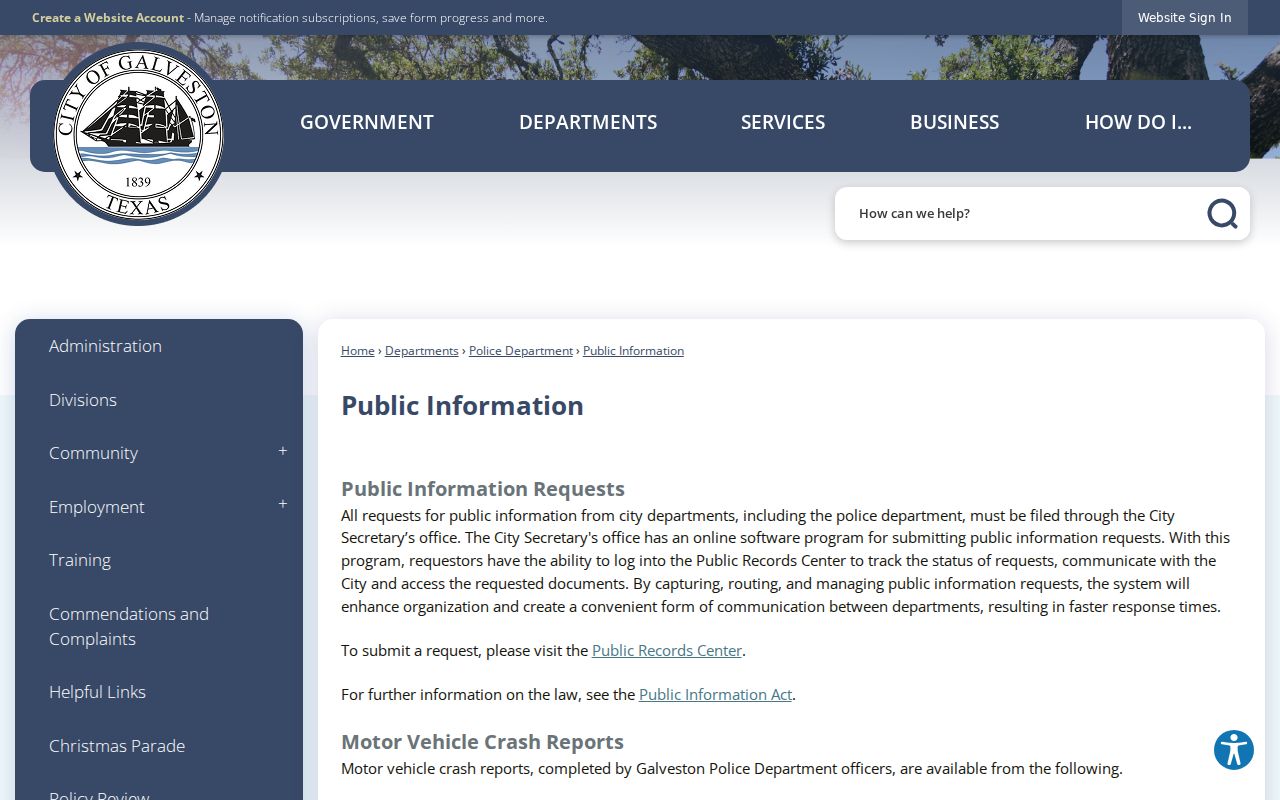
The portal's tracking and message functions are useful when the city needs clarification, applies redactions, or prepares an electronic production.
The Galveston Police Department
Galveston Police creates reports for city calls, investigations, crashes, and arrests. The department and Municipal Court share the public-safety complex at 601 54th Street, but each keeps different files. Use the Public Records Center for GPD records and call the police nonemergency line at (409) 765-3702 when the official city process directs a telephone contact.
A well-scoped request asks for an offense report, arrest report, call-for-service or CAD entry, 911 audio, body-camera recording, or another named record. Give the date and approximate time, location, incident number, and names. Texas law does not require the city to answer questions or create a new report. Video and audio may involve special identification rules, redaction work, and cost.
The official Galveston Police page identifies the department and its city role.

The department image marks the starting custodian for a GPD narrative, even when later custody and court records sit only blocks away.
Galveston Booking Records Nearby
Galveston County Jail is at 5700 Avenue H, and the Sheriff's Office is at 601 54th Street. Their proximity to city police does not merge the record systems. If GPD makes a custodial arrest and the jail accepts the person, GCSO creates the county booking. GPD still owns its officer report. This difference is one of the most important facts in an island records search.
| Galveston event record | Custodian | What it answers |
|---|---|---|
| GPD offense or arrest narrative | City Public Records Center | Officer action and allegations |
| County booking | GCSO P2C or jail records | Custody, initial charge, bond, and release |
| Municipal citation | Galveston Municipal Court | Fine-only city case and outcome |
| Higher filed charge | County or District Clerk | Pleadings, events, judgment, and sentence |
Ask each office only for the file it holds. That produces a clearer Galveston criminal record and avoids a broad request to the wrong custodian.
Arrests and Bookings in Galveston
A Galveston arrest begins with an agency report. Once county jail staff accept the person, they verify paperwork, collect identity answers, take a photograph and usually fingerprints, and create a booking entry. A magistrate then addresses warnings, probable cause, and bond. The prosecutor may decline, revise, or file the alleged charge later.
Use GCSO P2C Inmate Inquiry for present local custody. P2C Arrests and Daily Bulletin can show recent activity, while the jail line at (409) 766-2315 helps clarify identity or release status. A booking snapshot is not a conviction record. A complete case outcome comes from the appropriate court file after prosecution begins.
Note: Galveston booking data may appear before prosecutors file a case, so compare dates and initial charges instead of assuming the records conflict.
Galveston Municipal Docket Records
Galveston publishes current municipal dockets through an online archive. A docket is the court's schedule and event list. It can identify a setting or case activity, but it may not supply every document or the final signed disposition. Use the municipal court route or call the clerk when the archive lacks the needed case detail.
A city citation can result in a plea, trial setting, deferred disposition, defensive-driving route, payment plan, or another lawful result. Failure to respond may lead to a warrant, added fee, collections action, and driver-license-renewal denial. Since those consequences depend on the actual file, use the citation or case number and confirm the present status with the court.
Galveston Municipal Court Records
The Galveston Municipal Court prepares dockets, dispositions, correspondence, accounts, and payment plans for cases within city jurisdiction. It operates at 601 54th Street, Suite 300, Galveston, TX 77551, with telephone (409) 765-3740. Published hours are Monday through Friday, 8 a.m. to 4 p.m.; confirm holiday or docket changes before visiting.
| Court Name | Galveston Municipal Court |
|---|---|
| Case Types Heard | City ordinance, traffic, and fine-only Class C cases within Galveston jurisdiction |
| Case Lookup Channel | Online docket archive, court lookup or payment route, and assistance from the municipal clerk |
| What the Docket Shows | Case or citation identifiers, settings, activity, status, disposition, warrant or financial information when entered |
| Copies & Fees | Ask the clerk about copies; card payment requires the full balance and carries a convenience-fee warning |
The court accepts cashier's check, money order, or cash through approved channels, but cash must not be mailed. Telephone card payment requires the full balance. Confirm the total, identity fields, and current convenience charge before submitting payment.
The city's municipal court source shows the court contact and case options.
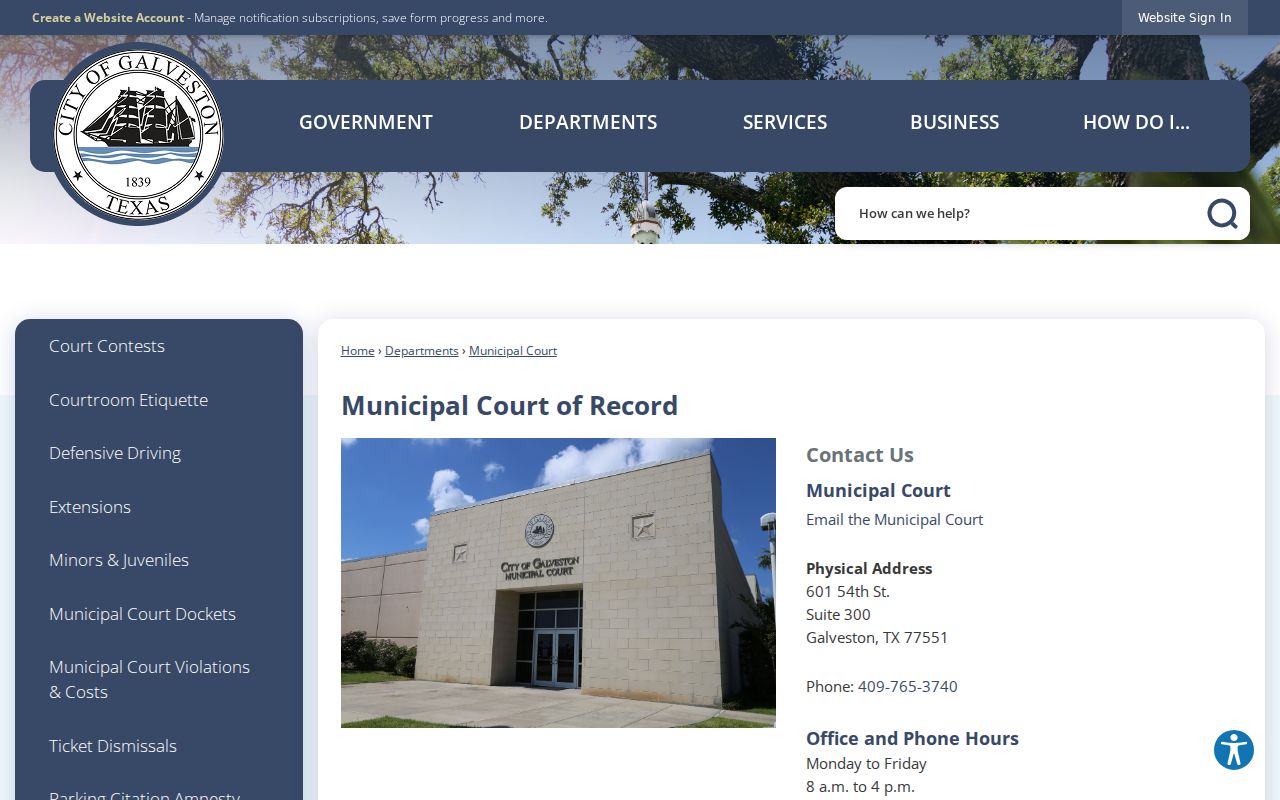
The interface helps distinguish a city citation from a county criminal prosecution that must be searched through Odyssey.
Galveston Citation Warrant Records
A failure to respond to a Galveston municipal citation can cause a warrant and added consequences. If that happens, contact Municipal Court with the citation or case number, name, and other identifiers the clerk requests. Ask for the current options involving an appearance, payment, plan, bond, or recall. Searching for the warrant does not clear it.
Do not assume a municipal warrant will appear in the same place as a felony or Class A or B misdemeanor warrant. City courts retain their fine-only process, while GCSO serves as the central depository for many county and district warrants. An attorney can advise on a safe response when appearing in person could result in arrest.
Warrant caution: Confirm a Galveston city warrant with the issuing court and follow its instructions before choosing an in-person response.
Where Galveston Records End Up
A Galveston city citation can stay with Municipal Court. A custodial event may create a GPD report and a GCSO booking. If prosecutors accept a Class A or B misdemeanor, the County Clerk keeps the court file. A felony case belongs with the District Clerk. Local courts then report qualifying dispositions to the Texas repository.
Record flow: Galveston Police Department › Galveston County Courts › Texas Department of Public Safety
The DPS public name search is limited to conviction and deferred-adjudication data Texas law permits for public dissemination. It is not a copy of the city report, county booking, or full court file. For a broader review of one's own fingerprint-linked Texas history, use DPS personal-review instructions. For full county case detail, the Galveston County criminal court case records route explains Odyssey and the clerk counters.
Galveston Court Record Terms
Two terms that sound alike can describe different outcomes. Deferred disposition is a municipal-court procedure that may allow a city case to be dismissed after the person meets court conditions. Deferred adjudication is a Texas criminal-court form of community supervision after a plea or finding without an immediate judgment of guilt. It may remain public unless a nondisclosure order applies.
- Docket
- The schedule and chronological record of court activity.
- Disposition
- The formal outcome, such as dismissal, conviction, or acquittal.
- Capias
- A court writ that commands an arrest, often tied to charging or a failure to appear.
- Expunction
- A court process that destroys or returns eligible records under Chapter 55A.
Read the signed order or judgment rather than inferring an outcome from a status label. A case marked disposed is finished at that stage, but disposed does not mean convicted.
Galveston Port Policing Records
Galveston's port, tourism traffic, campus agencies, and coastal events can put several custodians in the same small area. A Port of Galveston officer, UTMB Police officer, GPD officer, county deputy, or state trooper may create the first report. The place of booking does not change which agency owns that investigative file.
Ask who made the report and note the incident number on any citation or booking record. Request the narrative from that agency. Then use GCSO for county custody and the proper clerk for a filed case. This agency-first method is especially important during high-volume island events when recent booking data may move faster than prosecution records.
Galveston Records Across Two Eras
The island's record geography also reflects two eras of government. The historic 1892 courthouse stands at 722 Moody Avenue, while the modern Justice Center at 600 59th Street holds district and county courts, the clerks, and prosecutors. The modern court hub is the relevant stop for present criminal pleadings, judgments, and certified case copies.
Do not treat a historic-government address or a nearby police building as the present criminal-file counter. For felony copies, contact the District Clerk in Room 4001 at the Justice Center, (409) 766-2424. For misdemeanor court files, use the County Clerk court division in Suite 2001 and verify its direct contact before travel.
Public Access Rules
The Galveston Public Records Center processes city executive-branch requests under the Texas Public Information Act. It covers existing city records, subject to exceptions. Court case files follow court law and rules instead. A city request should not be used to seek county pleadings, and a court-record request should not be sent as a police TPIA request.
Active investigative material may be withheld under Government Code Section 552.108. Juvenile data, protected victim information, medical facts, motor-vehicle data, confidential identifiers, and sealed or expunged matters can be removed or withheld under other law. A ten-business-day deadline for seeking an Attorney General decision is not a promise that production will finish in ten days.
Key Statutes:
Texas Public Information Act, Government Code Chapter 552 permits requests for existing city records while allowing required exceptions and redactions.
Texas Government Code Sections 411.083 through 411.085 limit obtaining and releasing criminal-history information outside authorized channels.
Texas Rule of Judicial Administration 12 and court access policy distinguish judicial administrative records from court case files and executive-branch records.