
How to Check Criminal History in Texas City
A useful Texas City search begins with the kind of event involved. A city police report, a Class C citation, a local warrant, and a county-jail booking are separate files. A name alone may produce partial matches, so keep the incident number, citation number, date, location, and date of birth when those details are lawfully available. They help each custodian find the right record.
Use this five-part route to follow Texas City criminal records without treating one result as the whole history:
- Call the Texas City Police Department Records Division for a city offense or arrest report and identify the event as precisely as possible.
- Ask for the existing report, booking entry, audio, or other named record rather than asking staff to research a person or answer a legal question.
- Check Texas City Municipal Court when the matter is a city ordinance, traffic, or fine-only Class C case.
- Use Galveston County P2C and the county Odyssey Portal if custody or a higher charge moved beyond the city system.
- For a statewide self-review, follow the Texas Department of Public Safety personal-record process; its public name product is a more limited record.
The event may stop at any one of those points. A citation can stay in municipal court, while an arrest may create police, booking, court, and DPS entries over time.
Texas City Records at One Address
Texas City places its Police Department, Municipal Court of Record, and City Marshals Office at 1004 9th Avenue North, Texas City, TX 77590. The shared address is convenient, but the files are not interchangeable. Police records staff handle reports created by officers. Court staff maintain citations, dockets, dispositions, payments, and court audio requests. Marshals execute warrants issued through the municipal court.
Call the right unit before traveling. Police main and dispatch is (409) 643-5720, the Records Division is (409) 643-5818, booking or jail administration is (409) 643-5761, and Municipal Court is (409) 643-5800. A caller seeking a specific Texas City criminal record should state the file type first. This reduces the chance of being routed between offices that happen to share a building.
The Texas City Police Department
The Texas City Police Department creates reports for its own calls, investigations, and arrests. Its Records Division is the direct channel when a public police-report search form is not available. A focused request should name the event or case number, date, time, place, involved names, exact document, and preferred delivery format. That description asks for an existing record, which is what the Texas Public Information Act covers.
Not every part of a Texas City police file must be released. Active investigative material may be withheld through the statutory process. Juvenile information, protected victim details, medical facts, motor-vehicle data, and personal identifiers can also be removed. Ask for an itemized estimate if audio, video, or a large set may create charges. A police narrative remains with Texas City even if the arrested person later appears in the county jail.
Texas City Booking Records Split
Texas City publishes a local booking and jail-administration number, which means a person may be processed or held locally before transfer. Call (409) 643-5761 when the question concerns that local stage. For current county custody, use the official Galveston County P2C Inmate Inquiry or the county jail line at (409) 766-2315.
| Record question | First Texas City channel | Next check |
|---|---|---|
| Police report or arrest narrative | TCPD Records Division | Request from the agency that created it |
| Temporary local hold | TCPD booking administration | Confirm whether transfer occurred |
| Current county custody | GCSO P2C Inmate Inquiry | Call Galveston County Jail if unclear |
| Filed Class A, Class B, or felony charge | Galveston County Odyssey | Ask the proper county clerk for the judgment |
A local release or transfer can lag behind a live display. Record the booking number and time, then confirm status by phone rather than assuming that an older screen proves current custody.
Arrests and Bookings in Texas City
A Texas City arrest can produce several records in sequence. TCPD records the officer's basis, place, time, alleged offense, and action. A booking unit records identity, charge, bond, fingerprints, and custody. A magistrate addresses warnings, probable cause, and bond. Prosecutors decide whether and how to file, so the filed charge may differ from the police or booking label.
If Galveston County Jail accepts the person, P2C may show the booking before a court case exists. The daily bulletin and arrest search can add recent event context, while the Odyssey court system becomes useful after filing. The Galveston County arrest history resource gives more detail on county booking channels. Texas City police still remains the source for its investigative narrative.
Note: An arrest or booking is an allegation and custody event, not proof that a Texas City court entered a conviction.
Texas City Warrant Records and Marshals
The Texas City Marshals Office was created on August 10, 2016, to execute warrants from the Municipal Court of Record. Those are chiefly fine-only Class C matters. Marshals may make an arrest at a home, workplace, vehicle, or public place. A city warrant is therefore not the same record as a felony or misdemeanor warrant held through Galveston County systems.
When a Texas City warrant appears, contact Municipal Court at (409) 643-5800 and ask about the court's instructions for appearance, payment, a payment plan, bond, or recall. An online search does not clear the warrant. Do not appear merely to test whether the record is active. Keep a citation or case number ready, and get legal advice when the safest response is unclear.
Texas City Municipal Court Records
The Texas City Municipal Court of Record hears city ordinance and fine-only Class C charges. Filings may come from police, Animal Control, Fire Marshals, and Neighborhood Improvement Services under six bodies of law: the Alcoholic Beverage, city ordinance, Education, Health and Safety, Penal, and Transportation codes. Class A and B misdemeanors and felonies do not stay in this court.
| Court Name | Texas City Municipal Court of Record |
|---|---|
| Case Types Heard | City ordinance, traffic, and other fine-only Class C charges within city jurisdiction |
| Case Lookup Channel | Online payment route or clerk assistance by citation, case identifiers, name, and date of birth |
| What the Docket Shows | Charge, settings, plea or disposition, warrant status when entered, fines, costs, and payment activity |
| Copies & Fees | Ask the clerk for current copy costs; trial audio costs $25 and must be requested before trial |
Windows and phones operate Monday through Thursday from 7:30 a.m. to 5 p.m., and Friday from 7:30 a.m. to 4:30 p.m. Online or phone payments are available, with phone payment at (833) 259-4014. Verify any current service charge before paying.
Texas City Trial Audio Records
Texas City's court has a rare, time-sensitive rule for an audio record of trial. The party must request it before the trial, and the published charge is $25 at the time of request. Waiting until a hearing has ended may be too late to secure that recording through this process.
Ask the clerk how to place the request, how payment is documented, and what format will be supplied. This recording is not the same thing as the court docket or judgment. A Texas City criminal record review may need both: the docket shows formal events and outcome, while properly requested audio preserves what occurred in the trial proceeding.
Timing matters: Request Texas City trial audio before trial and confirm the current procedure directly with Municipal Court.
Where Texas City Records End Up
A fine-only city matter may begin and end at Municipal Court. A more serious arrest can move from TCPD into Galveston County Jail, then to a County Court at Law for a Class A or B misdemeanor or a District Court for a felony. The county clerk keeps misdemeanor court files, while the district clerk keeps felony files. Courts later report qualifying dispositions to the state repository.
Record flow: Texas City Police Department › Galveston County Courts › Texas Department of Public Safety
Each step answers a different question. The Texas City report describes police action. The booking record shows custody. The court file shows what prosecutors filed and how the judge resolved it. DPS connects reported fingerprint arrest cycles and outcomes, but its public name search shows only the part Texas law permits for public release.
Texas City Charges Change Custodians
Charge level determines where the lasting court record belongs. Texas City Municipal Court handles fine-only Class C matters. Galveston County's three County Courts at Law hear Class A and B misdemeanors, while its district courts handle felony cases. An initial arrest label may change after prosecutor review, and an enhancement may alter the level shown in the filed instrument.
Check the charging instrument and final judgment instead of relying on the booking label. If a city search finds no case, allow time for filing, then search the county Odyssey Portal by name and case number. A missing city result does not rule out a county file, and a county result does not transfer ownership of the original TCPD report.
Texas City Marshal Record History
The city's decision to form a dedicated marshals office in 2016 shows how Texas City separates court enforcement from general police records. Municipal Court issues its Class C warrants. Marshals execute them. Police maintain incident and arrest narratives. That local division matters when a reader sees a warrant reference but cannot locate a county criminal case.
The official Texas City Marshals page provides a view of the warrant unit and its role.
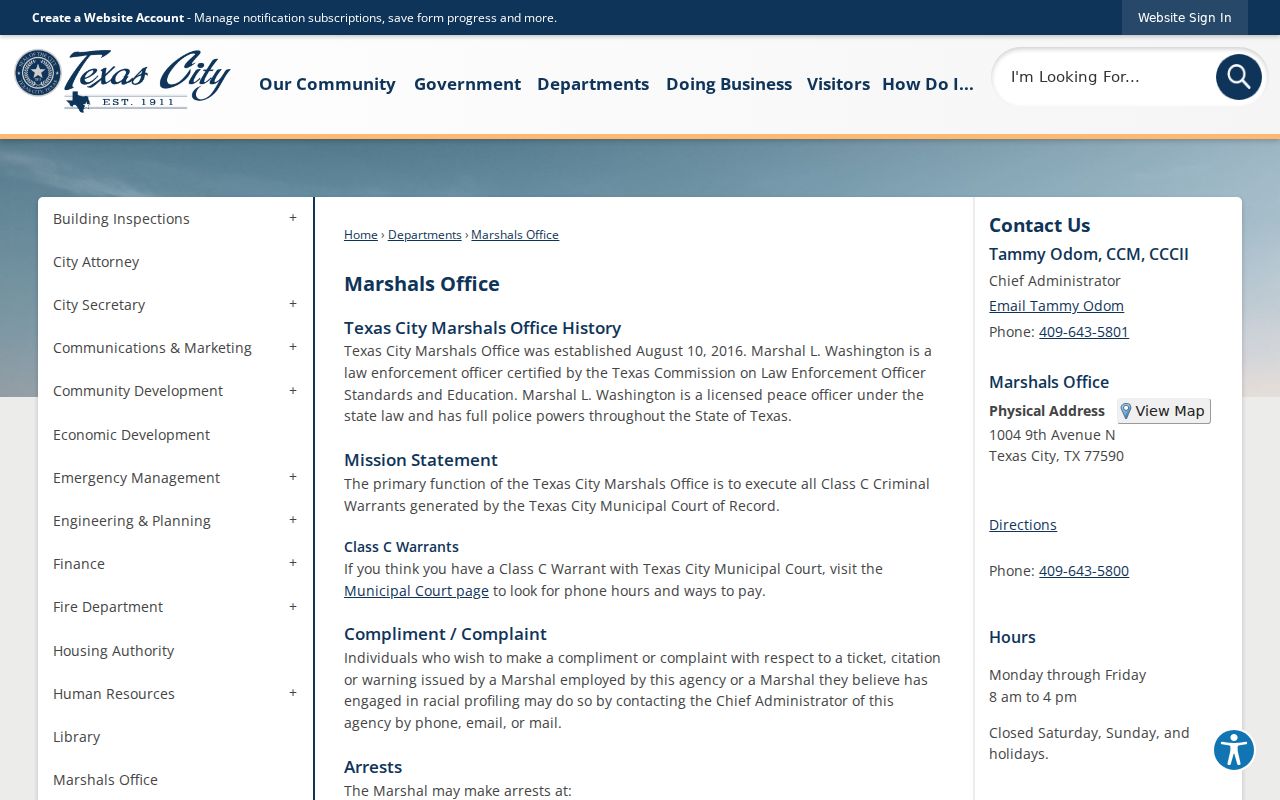
The image reinforces why the issuing court and its marshals are the right contacts for a Texas City Class C warrant, while county warrants follow a different route.
Public Access Rules
Texas City police and other executive-branch records fall under the Texas Public Information Act, but court case records follow court law and rules. A requester may inspect or seek copies of existing public records. The city need not answer questions, conduct legal research, or create a new list. Specific requests are easier to process and less likely to create avoidable labor cost.
Confidential criminal-history data, active-law-enforcement material, juvenile files, protected victim details, sealed matters, and sensitive identifiers may be withheld or redacted. If a city record becomes a county case, request pleadings and judgments from the correct clerk, not through a police-records request.
Key Statutes:
Texas Public Information Act, Government Code Chapter 552 gives access to existing government records while preserving statutory exceptions and redactions.
Texas Government Code Sections 411.083 through 411.085 restrict obtaining and releasing criminal-history record information except as state law authorizes.
Texas Code of Criminal Procedure Chapter 55A sets the court process and eligibility rules for expunction of covered arrest records.