
How to Check Criminal History in Galveston County
Begin with the record closest to the event. The Galveston County Odyssey Portal is the main public route for filed district and county criminal cases. GCSO Police-to-Citizen, or P2C, covers current inmates, recent arrests, daily bulletins, and wanted records. Municipal and justice courts keep fine-only cases that may never reach the county portal. Texas DPS adds a statewide public conviction and deferred-adjudication search, but its result is a limited repository view rather than a full court file.
Gather a full legal name, spelling variants, a date of birth when lawfully known, a likely date range, and any cause, incident, or booking number. Common names can produce several rows. A match should rest on more than a name, and the cause number should follow the inquiry from the search list to the judgment.
- Search Odyssey by party name or cause number, then select the criminal case context and the correct Galveston County court.
- Check GCSO P2C for a current booking, recent arrest, daily incident entry, or wanted record.
- Open the detailed record and compare the date, court, agency, charge, and status before treating it as a match.
- Ask the District Clerk for a felony file, the County Clerk for a Class A or B misdemeanor file, or the city or justice clerk for its Class C matter.
- Use DPS personal review when checking your own Texas repository record, and obtain a certified disposition when the outcome must be confirmed.
Galveston County Criminal Record Chain
One incident can create four records with four custodians. The arresting agency writes the incident or arrest report. Galveston County Jail creates the booking entry after it checks the officer's paperwork and takes identity data, a photograph, and usually fingerprints. A prosecutor may then decline, revise, or file charges. Once filed, the proper clerk opens the court case. DPS receives the arrest event and later depends on courts and clerks to report the disposition.
| Record | Primary custodian | Best question it answers |
|---|---|---|
| Police report | GCSO or the city police agency | What officers recorded about the event |
| Booking record | Galveston County Jail | When and why a person entered local custody |
| Court file | District, County, municipal, or justice clerk | What was filed and how the case ended |
| DPS history | Texas DPS Crime Records | What the state repository may lawfully release |
The sequence explains why a new jail entry may precede a court case and why an arrest charge can differ from the filed count. No single row proves the whole history.
The official GCSO page shows the sheriff's record-system links and local command information.

Those links make GCSO the practical starting point for county bookings and warrants, while city police narratives remain with the city that wrote them.
Official Texas Background Checks
The Texas DPS Criminal History Search offers the public a name-based product showing convictions and deferred adjudications DPS may disseminate under Government Code Chapter 411. An account and search credits are required. DPS commonly describes one credit as $3, and card processing costs may be added. It is not a subject's complete fingerprint-supported record, and incomplete reporting or a weak name match can affect the result.
For self-review, follow DPS personal-record instructions and the authorized fingerprint route. IdentoGO by IDEMIA runs Texas FAST enrollment. A service code identifies the authorized purpose, after which the person selects an appointment, presents approved identification, and completes electronic fingerprints. A local police fingerprint card is a separate service and should not be treated as a FAST submission.
| Official product | Scope | Access |
|---|---|---|
| DPS public name search | Public Texas conviction and deferred data | Account and search credit |
| DPS personal review | Your fingerprint-linked Texas record | DPS process and authorized fingerprints |
| FBI Identity History Summary | Your national FBI submission history | Subject only, fingerprints, and FBI fee |
Galveston County Fingerprint Record Review
FAST locations and hours can change, so select a Galveston County or nearby appointment inside the vendor locator instead of relying on a map listing. Enrollment needs the service code provided by DPS or another authorizing agency. The page then collects identity and contact data, displays the available sites and times, and states the transaction cost before capture.
The official IdentoGO enrollment page shows that service-code and appointment path.
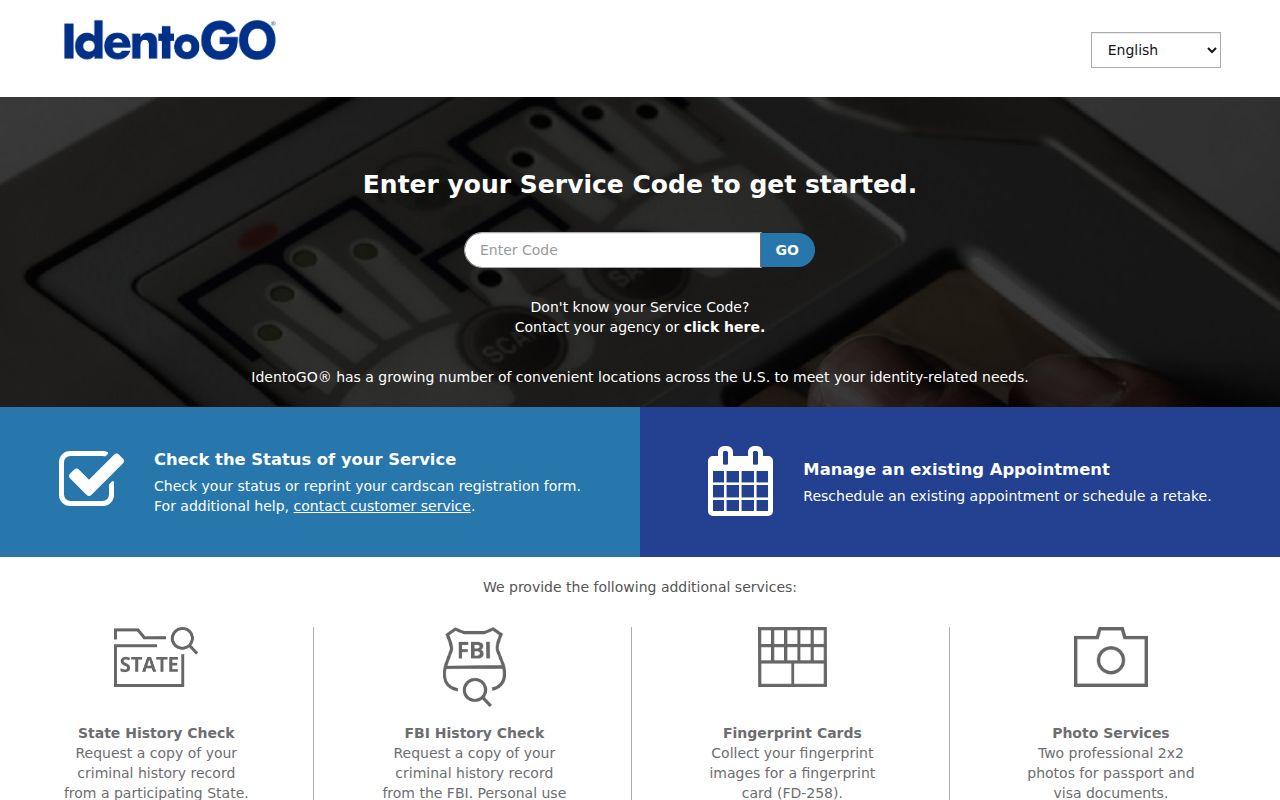
Use the code tied to the authorized request. A fingerprint check is useful for reviewing your own linked history because it reduces the uncertainty caused by shared or changed names.
An FBI Identity History Summary is also subject-only. The FBI's electronic option collects identity data and the direct $18 fee, then requires fingerprints through a participating USPS site or an instructed fingerprint-card mailing. It does not replace local police narratives or Galveston County court documents.
Types of Criminal Records
Galveston County criminal records are organized by event and legal stage. A booking record shows intake. A charging instrument states the accusation a prosecutor filed. A court judgment records the outcome. Warrant, custody, supervision, and registry systems each answer narrower questions and have their own access limits.
- Incident and arrest reports: the exact law-enforcement agency that created the report keeps it.
- Bookings and jail records: GCSO records county-jail intake, custody, bond, and release events.
- Criminal case files: the District Clerk keeps felony files, while the County Clerk keeps Class A and B misdemeanor cases.
- Warrants: GCSO maintains many district and county warrants, while constables, marshals, and city courts hold other warrants.
- Custody and supervision: GCSO covers local jail custody, TDCJ covers state imprisonment and parole, and CSCD manages local community supervision.
- Registry records: DPS publishes qualifying sex-offender information, with local verification handled by law enforcement.
P2C Galveston County Record Searches
GCSO's P2C gateway groups several high-use tools in one official system. Inmate Inquiry searches current custody by last and first name. Arrest Search and the Daily Bulletin help trace recent activity. The Wanted list gives a public lead, but it is not a real-time certification that a warrant remains active. Confirm status with GCSO and the issuing court before acting.
| Inmate Inquiry | Current county custody, searched by name |
|---|---|
| Arrest Search | Recent arrest events with available date and name filters |
| Daily Bulletin | An official blotter-style view of incidents and arrests |
| Wanted List | Published wanted entries that still require direct confirmation |
The official Galveston County wanted list illustrates the public search route.
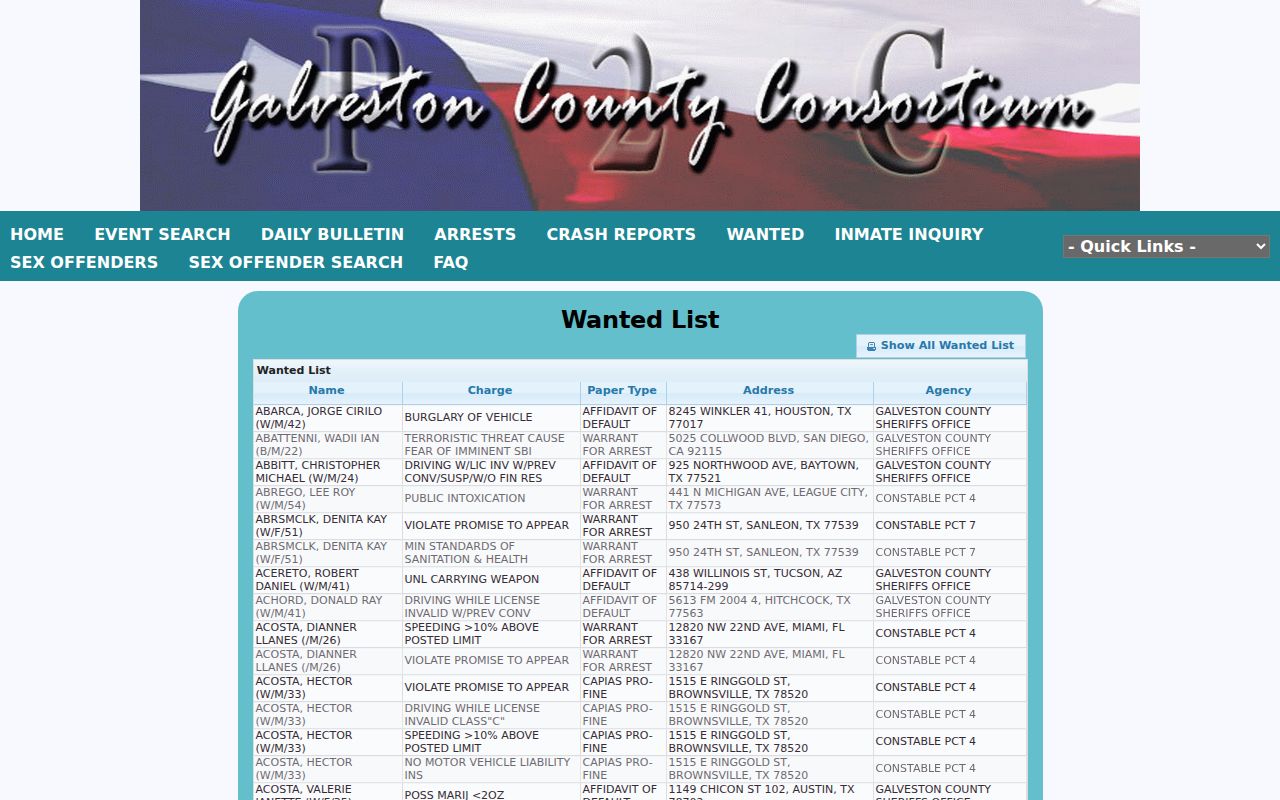
A list result is a reason to call, not a way to clear a warrant. Precinct 3 also publishes a direct JP resolution route through its clerk for many fine-only matters.
What a Galveston County Criminal Record Shows
A Texas criminal-history record links identity details to arrest cycles and reported outcomes. A court file is narrower and centers on one cause number. A booking file centers on one jail intake. Public views omit sensitive identifiers and protected files, so the visible fields depend on the custodian and the user's access role.
| Name and identifiers | Names, aliases, birth details, descriptors, and repository numbers where release is allowed |
|---|---|
| Arrest and booking data | Agency, event date, tracking number, initial charge, bond, and custody status |
| Charges and statutes | Alleged offense, filed count, degree, and the law cited in the case |
| Disposition | Dismissal, deferred adjudication, conviction, acquittal, or another completed result |
| Sentence | Confinement, fine, restitution, or community-supervision terms shown in the judgment |
| Custody or supervision | Local jail, TDCJ, probation, or parole status when the relevant system publishes it |
Disposed means a court has completed a disposition. It does not mean convicted. A dismissal also does not erase a separate booking record. Read the judgment before drawing a conclusion.
Galveston County Jail or TDCJ
Custody searches change after sentencing and transfer. GCSO P2C is the right local source for a person held before trial, serving applicable local time, or awaiting release paperwork. The Texas Department of Criminal Justice becomes the source after transfer into state custody. Texas VINE can send custody-status notices, but it is not a full criminal-history record.
The TDCJ Online Inmate Search provides the state's sentenced-prisoner form.
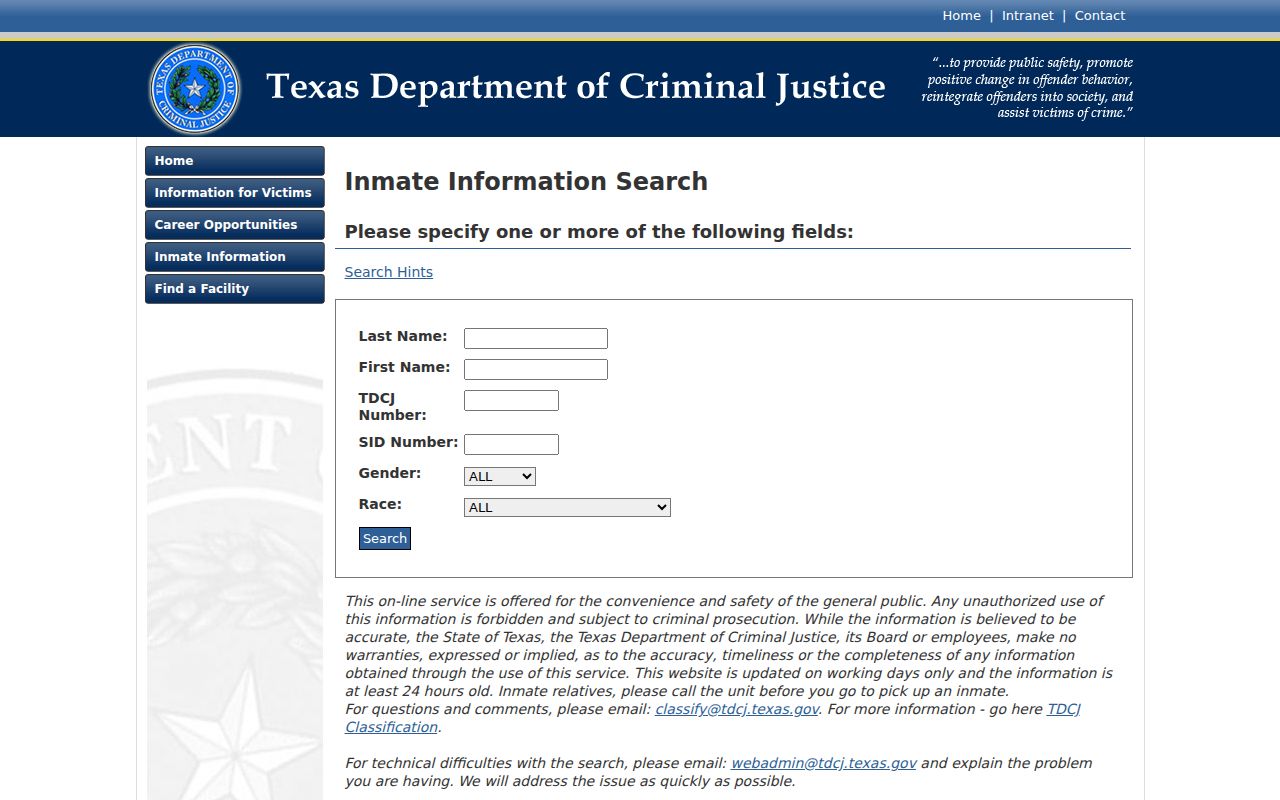
Search by the identifiers the state form accepts. If a person recently left Galveston County Jail, allow for transfer processing and confirm unclear status with the agency that presently holds custody.
GCSO's own release account explains another delay. Release enters the queue only after all required payment and paperwork arrive, and staff then recheck both documents and identity. A bond payment on one line may not resolve other cases or holds.
Public Access Laws
The Texas Public Information Act covers existing records held by county and city executive agencies, subject to exceptions and redaction. Court case records use court rules, statutes, and common law instead. Texas criminal-history information has its own dissemination limits under Government Code Chapter 411. These routes are related, but they are not interchangeable.
Key Texas authorities:
Government Code Chapter 552 gives access to existing government records while allowing lawful withholding and redaction.
Government Code Sections 411.083 through 411.135 control criminal-history confidentiality and the public DPS product.
Texas Rule of Judicial Administration 12 governs judicial administrative records, not ordinary case-file access.
Code of Criminal Procedure Chapter 55A sets Texas expunction grounds and procedures.
A government body seeking to withhold requested material may face a ten-business-day deadline to seek an Attorney General decision. That is not a promise that records will be produced in ten days. Active investigations and confidential juvenile, victim, medical, and identifying information may be withheld or redacted.
Galveston County Criminal Court Custodians
Charge level points to the correct counter. The five general-jurisdiction district courts at the Justice Center hear felony matters. County Courts at Law 1, 2, and 3 hear Class A and B misdemeanors. Municipal and justice courts handle their own fine-only Class C cases and warrants. The 306th District Court is a family court, not an adult criminal trial court.
District Clerk
600 59th Street, Room 4001
Galveston, TX 77551
(409) 766-2424
Monday through Friday, 8 a.m. to 5 p.m.
League City Clerk Counter
174 Calder Road
League City, TX 77573
(281) 316-8729
Monday through Friday, 7:30 a.m. to 5:30 p.m.
Galveston County Sheriff
601 54th Street
Galveston, TX 77551
(409) 766-2300
The clerk can provide plain or certified case copies and a current cost estimate. GCSO handles its own incident, booking, custody, and many warrant records, but it cannot supply a complete League City, Galveston, or Texas City police narrative just because the person entered the county jail.
Sealed, Expunged & Restricted
Texas expunction can require eligible records to be destroyed or returned. An order of nondisclosure keeps covered history from ordinary public release while preserving access for agencies named by law. Juvenile files, protected victim details, medical data, sealed matters, and confidential identifiers also stay outside routine public searches.
Chapter 55A eligibility depends on the arrest episode and its result. Acquittal, specified pardons, qualifying release without final conviction, certain pretrial interventions, prosecutor certification, and mistaken identity may support relief. Related charges can block a partial expunction. Deferred adjudication usually points toward nondisclosure instead.
When venue lies in Galveston County, obtain certified dispositions before preparing a district-court petition. Identify every agency holding the record so each can receive the order. Fees change, so request the current filing and service total from the District Clerk. After an order, confirm the county portal and your DPS personal record because downstream systems may update at different times.
Galveston County Record Access Changed
The local court search changed at the end of 2025. The legacy Tyler Public Access site announced that support ended on December 31 and directed users to the newer local Odyssey Portal. Its notice also states that re:SearchTX is for family, probate, and civil cases in this setting. That makes Odyssey, not a broad statewide search claim, the sound route for Galveston County criminal dockets.
The District Clerk reports broader scanning and electronic filing, more online access, and digitization work reaching back more than a century in some historical collections. Older or document-level criminal files can still require a counter request. An online index does not guarantee a downloadable or free image.
- Cause number
- The court's unique identifier for one filed case.
- Disposition
- The outcome, which may be a conviction, dismissal, acquittal, or other resolution.
- Deferred adjudication
- Supervision without an immediate judgment of guilt; completion does not by itself erase the public file.
- Capias
- A court writ directing an arrest, often tied to a filed case or nonappearance.
Criminal Records by City in Galveston County
The county's island and mainland geography divides police-report custody. League City, Texas City, and Galveston each keep city reports and municipal court files, while higher charges and county-jail bookings move into Galveston County systems. The three city routes below match the largest incorporated cities in the Census Bureau's July 2025 estimates.
League City Criminal History
119,905 residents · Police records, JustFOIA requests, and municipal cases
Texas City Criminal History
59,733 residents · Police records, local booking contacts, court, and marshals
Galveston Criminal History
53,636 residents · City Public Records Center and municipal docket access